
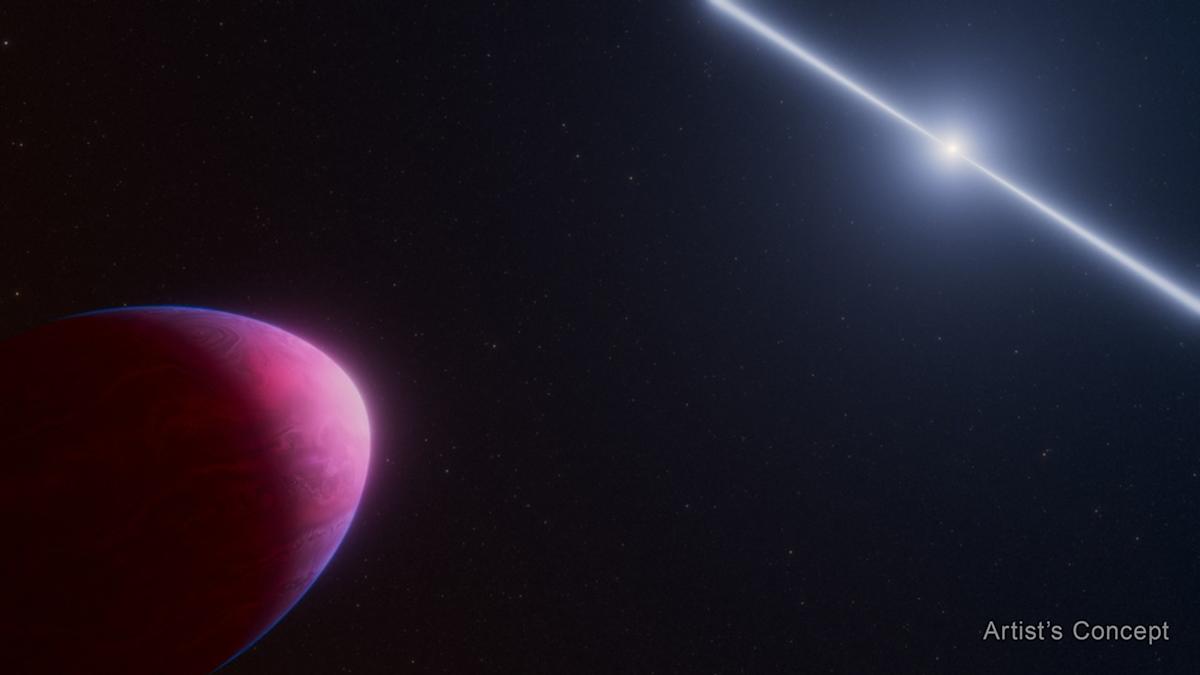
Astronomers discover mysterious lemon-shaped exoplanet with NASA's Webb telescope
Area is stuffed with unsolved mysteries, and a staff utilizing NASA’s James Webb Area Telescope have lately turned up a doozy. “I bear in mind after we acquired the info down, our collective response was ‘What the heck is that this?’ It is extraordinarily completely different from what we anticipated,” mentioned Peter Gao of the Carnegie Earth and Planets Laboratory in Washington, a co-author on the research.
The researchers discovered an exoplanet dubbed PSR J2322-2650b that orbits a small, dense star emitting electromagnetic radiation referred to as a pulsar. They’re an instance of a black widow system, the place a quickly spinning pulsar is paired with a smaller astronomical physique. A black widow duo isn’t uncommon, however this pair has sparked questions on how the exoplanet initially shaped.
The exoplanet’s proximity to the pulsar and its intense gravitational pull have distorted it into an rectangular lemon form. Extra unusually, PSR J2322-2650b additionally has a novel ambiance comprised principally of helium and carbon. “As an alternative of discovering the traditional molecules we anticipate to see on an exoplanet — like water, methane, and carbon dioxide — we noticed molecular carbon,” principal investigator Michael Zhang of College of Chicago mentioned. Given its unusual ambiance, the staff is not sure how the exoplanet shaped. “It’s totally arduous to think about the way you get this extraordinarily carbon-enriched composition. It appears to rule out each identified formation mechanism,” Zhang mentioned. For now, we’ll chalk this up as one other thriller of the universe.