
Don’t anticipate Trump Media’s nuclear fusion energy plant to generate electrical energy quickly
Trump Media — yup, the father or mother firm of Fact Social — is the newest entrant within the close to century-long race to develop a nuclear fusion energy plant. It introduced a merger settlement with fusion firm TAE Applied sciences on Thursday and a daring plan to interrupt floor on the primary utility-scale fusion plant a while in 2026.
TAE doesn’t plan to start out producing energy from its first plant till 2031, which continues to be an extremely formidable timeline. There’ll seemingly be a myriad of monetary and regulatory points to deal with alongside the way in which, after all. However the scientific and engineering challenges to beat, which we’ll dive into right here, are additionally huge.
Fusion is taken into account the ‘Holy Grail’ of unpolluted power applied sciences
Fusion is taken into account the ‘Holy Grail’ of unpolluted power applied sciences, and AI firms are salivating over it as a possible supply of ample electrical energy for information facilities. However whereas a future fusion reactor may someday assist remedy a few of humanity’s complications, it might simply be wishful pondering to anticipate them to come back to the rescue for information facilities anytime quickly.
Why would Trump Media care about fusion?
With fusion, scientists try to copy the way in which stars create mild and warmth — atomic nuclei fuse collectively, producing an amazing quantity of power. A fusion energy plant might keep away from the greenhouse gasoline emissions from fossil fuels which are inflicting local weather change, in addition to the radioactive waste that right now’s nuclear fission reactors create by splitting atoms aside to supply power.
President Donald Trump has made his disdain for clear power clear by falsely calling local weather change a “con job,” ending tax incentives for renewables, and halting federal funding and permitting for photo voltaic and wind initiatives. However he has aligned himself with the tech broligarchy in making an attempt to hurry the development of latest AI information facilities. energy these energy-hungry services has change into a serious hurdle for the trade, upsetting pushback from communities throughout the US involved about new information facilities doubtlessly driving up electrical energy charges and air pollution.
Massive names in tech are funneling cash into fusion within the hopes that it would change into a silver bullet for everybody’s power woes. Google and Microsoft have introduced agreements to buy electrical energy from fusion energy crops that different firms plan to finish by the late 2020s or 2030s. Sam Altman, Invoice Gates, and Jeff Bezos have additionally backed startups growing their very own fusion applied sciences.
“Fusion energy would be the most dramatic power breakthrough for the reason that onset of business nuclear power within the Fifties — an innovation that may decrease power costs, increase provide, guarantee America’s AI supremacy, and revive America’s manufacturing base, and bolster nationwide protection,” Devin Nunes, Trump Media Chairman and CEO, stated on a Thursday investor name.
There are not any utility scale nuclear fusion energy crops but, regardless of the push of initiatives to design one that may truly work. Success nonetheless will depend on researchers fixing vital scientific and engineering unknowns that they’ve been plugging away at for many years.
How do we all know TAE and Trump Media can truly make fusion energy crops a actuality?
We don’t. As you’ll be able to think about, recreating the dynamics of a star on Earth may be very troublesome. It takes an unlimited quantity of power simply to kick off a fusion response. A stumbling block scientists have confronted for many years — and nonetheless face — is tips on how to obtain a internet power achieve from a fusion response.
The primary time anybody on this planet was in a position to obtain that internet power achieve, also known as ‘ignition,’ was in 2022 on the Lawrence Livermore Nationwide Laboratory’s Nationwide Ignition Facility (NIF). No different group, together with TAE, has but been in a position to do that with their very own know-how,.
The 2022 breakthrough at Lawrence Livermore was achieved by firing 192 laser beams at a diamond-encased pellet of gasoline. It’s a type of inertial confinement, triggering a fusion response by compressing and heating a fuel-filled goal. One other competing fusion know-how is named a tokamak, which makes use of magnetic fields to restrict plasma and set off the response.
Recreating the dynamics of a star on Earth may be very troublesome
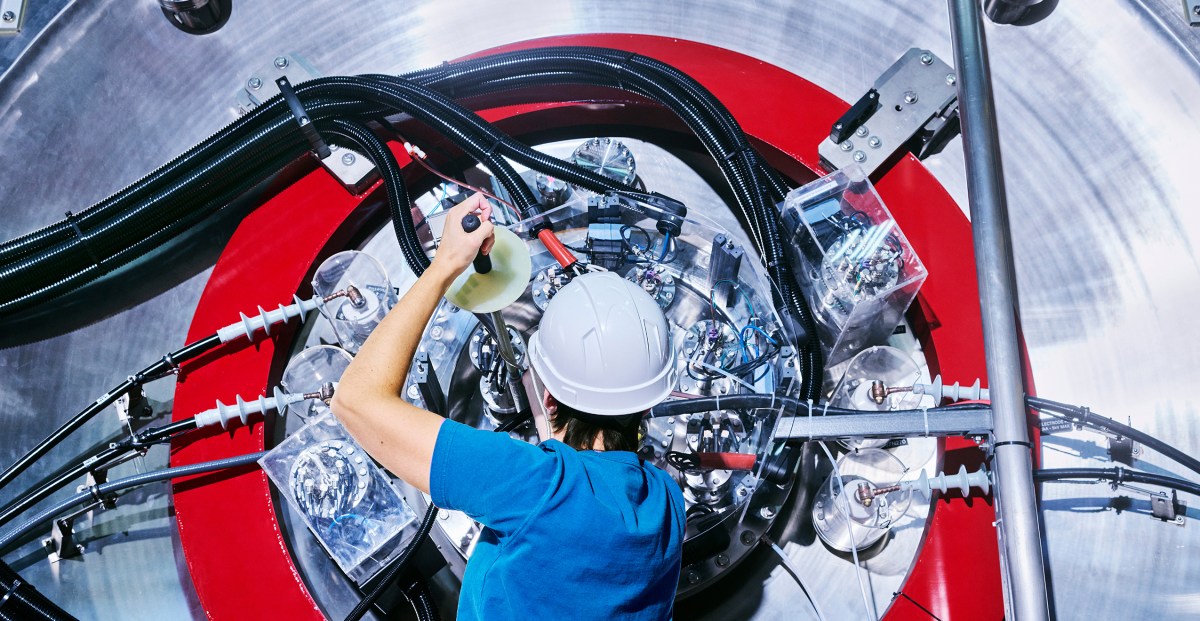
You possibly can consider the reactor TAE is growing as a type of a hybrid of each methods, utilizing what’s known as area reverse configuration (FRC). It nonetheless makes use of magnetic fields to lock plasma into place, and likewise shoots beams of gasoline instantly into the plasma to stabilize it and create the circumstances needed for a response to happen.
So when are we going to have electrical energy from nuclear fusion?
Most specialists The Verge has talked to through the years have been cautious to place a date on when a industrial fusion energy plant might truly begin powering properties and companies.
Not solely does TAE nonetheless must reveal that it will probably obtain a internet power achieve — that achieve must be large enough to make financial sense. The Lawrence Livermore breakthrough, for instance, achieved a internet power achieve of 1.5 megajoule achieve (the experiment yielded 3.15 megajoules of power in comparison with the two.05 megajoules the lasers used to set off the fusion response). A laser fusion energy plant would seemingly want to realize a achieve of fifty to 100. The lab has repeated its experiments to work to get larger positive aspects — reaching a report achieve of 4.13 MJ in April of this yr.
That’s all to say that there are nonetheless lots of milestones for the trade to achieve. The Trump administration launched a roadmap in October for the development of fusion applied sciences, and the Division of Vitality has set a aim of deploying commercial-scale fusion energy to electrical energy grids by the mid-2030s.
“We’re actually at type of that first-of-kind know-how innovation, and it’s type of onerous to assign direct timelines to those issues,” says Patrick White, group Lead of fusion power security and regulation on the Clear Air Job Pressure. “As [TAE starts] taking a look at both constructing a scientific demonstration machine or going straight to a industrial prototype, these varieties of machines take a considerable quantity of funding. And this [merger] doubtlessly goes to be a pathway for them to obtain the capital they should truly begin testing and deploying their fusion know-how.”
Business fusion reactors would additionally want sturdy provide chains for gasoline and supplies sturdy sufficient to face up to the intense stress and temperatures needed for nuclear fusion. Briefly, designing a working reactor can be an unlimited step ahead — however then comes tougher work to construct the infrastructure and enterprise round it.
Then how massive a deal is that this merger?
The most important influence this merger is prone to have — if it in the end goes by — is to infuse much more money into TAE’s ambitions.
TAE, based in 1998, claims that its analysis has superior sufficient to the purpose that “capital is now changing into our greatest problem,” TAE CEO Michl Binderbauer stated on the investor name.
Trump Media has agreed to shell out $300 million to TAE as a part of the transaction. That provides to the greater than $1.3 billion in personal capital that TAE says it has raised thus far from Google (TAE has been partnering with Google since 2014 to include machine studying into its analysis), Chevron Know-how Ventures, Goldman Sachs, and others.
With that cash, TAE says it’ll be capable of begin building on its first utility-scale fusion plant by the tip of 2026, and generate “first energy” in 2031. The primary plant is meant to have a capability of fifty MWe, just like a fission microreactor. TAE didn’t instantly reply to questions from The Verge about the place that facility can be situated and the way a lot it might value. However the firm’s already planning to construct extra fusion crops after that with a capability reaching as much as 500 MWe.
These plans are additionally contingent on regulatory approvals. However in a controversial resolution by the Nuclear Regulatory Fee that was codified by Congress this yr, fusion reactors are regulated as particle accelerators within the US, just like tools utilized in most cancers therapies and to sterilize medical tools. That permits fusion crops to bypass prolonged federal licensing necessities that apply to fission reactors.
TAE has developed 5 iterations of its fusion reactor design, and stated as just lately as April that it deliberate to unveil its sixth, known as Copernicus, “earlier than the tip of the last decade.” From there, it might work towards growing the corporate’s first prototype energy plant, Da Vinci, “within the early 2030s.”
Then in November, TAE introduced that it’s now leapfrogging over Copernicus and shifting straight to Da Vinci. That’s a results of its newest fusion analysis reactor, Norm, being small and environment friendly sufficient to shave down prices by as much as 50 p.c, based on TAE.
“Norm is such an amazing breakthrough that it renders Copernicus pointless – saving us appreciable time and value,” Binderbauer stated in a November press launch.
Nevertheless it’ll nonetheless be resource-intensive for TAE to take the subsequent leap in its reactor design. “As [TAE starts] taking a look at both constructing a scientific demonstration machine or going straight to a industrial prototype, these varieties of machines take a considerable quantity of funding,” CATF’s White says. “And this [merger] doubtlessly goes to be a pathway for them to obtain the capital they should truly begin testing and deploying their fusion know-how.”